

CEOSpeaks · 28 October 2026
How your ₹1,000 Travels Through India’s Stock Market and Mutual Fund System
Liked this? Tag @rsplconsulting on Instagram and let us know what you think.
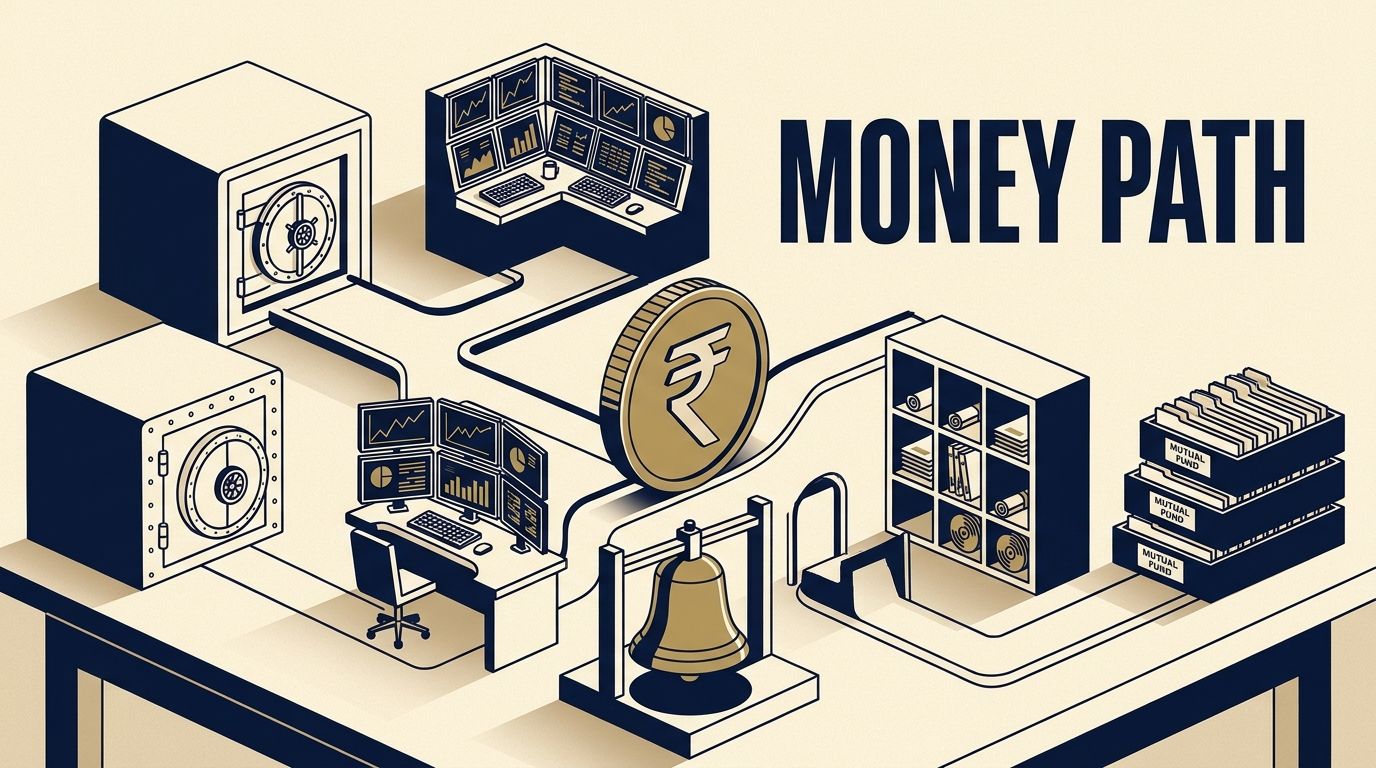
- StartAkshay funds ₹1,000 through the app
- Broker & ExchangeOrder is sent to NSE or BSE and matched with a seller
- Clearing CorporationSettlement is guaranteed and cash-securities exchange is secured
- Taxes & FeesSTT, stamp duty, SEBI fee and GST are collected
- Depository CreditShares are credited directly to Akshay’s demat account
Meet Akshay. He is sitting in Raipur with exactly ₹1,000 in his bank account and wants to invest it through a financial app on his smartphone. What looks like a simple tap on a screen actually sets off a tightly regulated chain involving identity verification systems, banks, payment rails, brokers, exchanges, clearing corporations, depositories, mutual fund platforms, registrars, custodians, regulators and the government.
This is the full journey of Akshay’s ₹1,000 through the Indian capital markets, including the institutional flow of money, digital identity checks, visible charges, embedded costs and future fees.
Akshay’s journey begins before any money moves at all. The first barrier is identity and compliance.
Akshay taps “Open Account” on the app. The app acts as both a stockbroker and a SEBI-registered Depository Participant (DP). He uploads his PAN card, enters his Aadhaar number, links his bank account and records a 5-second live video for video verification.
Behind the screen, several verifications happen almost instantly. The broker sends Akshay’s PAN details to the Income Tax Department through the CBDT framework to verify that his tax identity is valid and active. Akshay then enters a 6-digit OTP, which triggers the Aadhaar-based authorization flow through UIDAI for digital eSign confirmation. The entire KYC set is then compiled and sent to a KYC Registration Agency, such as CAMS KRA or CVL.
The KRA checks the central database, verifies that Akshay is a genuine individual and marks his profile as KYC compliant across the market ecosystem.
Akshay pays ₹0 for this onboarding process. The cost is typically absorbed by the broker as part of customer acquisition.
Once the account is active, Akshay moves to the funding stage.
He enters ₹1,000 in the fund transfer section of the app and chooses UPI.
His bank, which operates under RBI regulation, registers the request and debits exactly ₹1,000 from his account. The transaction then moves through NPCI, which routes the UPI payment. If Akshay had used net banking instead, a payment gateway such as Razorpay or BillDesk would typically process that leg. These payment gateways usually charge a very small processing fee, often below 10 to 50 paise on small transactions, but this is usually paid by the broker in the background rather than directly charged to Akshay.
The ₹1,000 is then credited to the broker’s upstream client account. This is not the broker’s operating money. Under SEBI’s client asset segregation requirements, it sits in a ring-fenced account separate from the broker’s own business funds. The broker cannot use this money for internal expenses such as salaries, software servers or electricity bills. The funds continue to belong to Akshay.
At this point, Akshay has two broad routes available: he can use the direct equity route and buy shares, or he can use the mutual fund route. These are alternative scenarios for the same ₹1,000, not sequential stages through which the same money passes.
In the direct equity route, Akshay decides to buy shares of a blue-chip company. He selects a delivery order, meaning he wants to take long-term ownership of the shares. His objective is to buy exactly ₹1,000 worth of stock.
A crucial rule applies here: the frictional charges sit over and above the investment amount. So if Akshay wants ₹1,000 worth of actual stock, the amount that ultimately leaves his bank balance is ₹1,001.56.
The movement of the order and funds follows this sequence:
[Akshay's App] -> [Stock Exchange] -> [Clearing Corporation] -> [Govt/Regulators/Depository]
The broker sends Akshay’s buy order to the stock exchange, such as NSE or BSE. The exchange’s matching engine finds a corresponding seller elsewhere in India. For this order matching and transaction infrastructure, the exchange charges ₹0.35, calculated at 0.0345% of the trade value.
The exchange then passes the completed trade details to the clearing corporation, such as NCL or ICCL. The broker transfers Akshay’s ₹1,000 principal along with the applicable charges into the clearing corporation’s settlement bank account. The clearing corporation acts as the guarantor for settlement. It holds the money, verifies that the seller actually owns the shares being sold and ensures that cash and securities exchange safely so that neither side defaults.
Before the transaction is fully completed, statutory levies are collected.
The Central Government collects Securities Transaction Tax of ₹1.00, calculated at 0.1% of the delivery value. It also collects stamp duty of ₹0.15, calculated at 0.015% of the transaction value. SEBI collects a regulatory turnover fee of ₹0.001, or 0.0001%, to support market oversight and policing functions. In addition, the GST system applies 18% GST on the relevant service fees charged by the broker and the exchange, which adds ₹0.06 in this case.
On brokerage, the position depends on the broker model. Many modern discount brokers charge ₹0 brokerage for long-term delivery equity transactions. However, if Akshay were using a traditional broker or placing an intraday trade, a brokerage fee of up to ₹20 could apply, along with 18% GST on that brokerage.
After settlement processing, the ₹1,000 principal reaches the seller’s broker. In return, the clearing corporation ensures that the shares are delivered directly into Akshay’s demat account through the depository system, such as CDSL or NSDL, using the direct payout mechanism. The shares do not pass through the broker’s own holding system. Akshay then receives an automated SMS from CDSL or NSDL confirming that he is the legal holder of the securities.
There is also a future charge that does not apply on the purchase date. The depository does not charge Akshay anything to receive the shares. But when he eventually sells them, the depository participant typically levies a flat DP charge of roughly ₹13.50 to ₹20.00, which is deducted from his balance.
The direct equity cost structure on a ₹1,000 delivery purchase is as follows:
| Charge Component | Amount on ₹1,000 | Basis/Rate | Who Receives It |
|---|---|---|---|
| Investment principal | ₹1,000.00 | Actual stock purchase value | Seller side via settlement |
| Exchange transaction fee | ₹0.35 | 0.0345% | Stock Exchange |
| STT | ₹1.00 | 0.1% of delivery value | Central Government |
| Stamp Duty | ₹0.15 | 0.015% of transaction value | Central Government |
| SEBI turnover fee | ₹0.001 | 0.0001% | SEBI |
| GST on service fees | ₹0.06 | 18% on applicable fees | GST system |
The total amount charged to Akshay’s bank account for ₹1,000 of delivery stock is ₹1,001.56.
If Akshay chooses the mutual fund route instead, the structure changes significantly.
There are no extra visible charges billed over and above the ₹1,000 at the time of purchase. Instead, the institutions involved take their share gradually from the investment itself through the fund’s annual expense ratio.
Assume the mutual fund has a 2% annual expense ratio. On a ₹1,000 investment, that translates to ₹20.00 per year. This is not deducted as a one-time bill. It is accrued and sliced out of the fund pool daily, which works out to roughly 5 paise per day.
The route followed in this case is:
[Akshay's App] -> [Clearing Platform] -> [RTA Database] -> [Custodian Vault Bank] -> [AMC Fund Pool]
First, where the platform is acting as a mutual fund distributor, the relevant AMFI/SEBI registration requirements apply, including use of a valid AMFI Registration Number, or ARN, where applicable.
Next, the app routes the transaction directly through exchange-run mutual fund infrastructure such as BSE StAR MF or NSE NMF II, rather than through the broker pool used in a stock purchase.
The transaction data then reaches the Registrar and Transfer Agent, such as CAMS or KFintech. The RTA serves as the backend record-keeping engine. It records Akshay’s name, updates his bank mandate and calculates the exact number of mutual fund units allotted to him based on the scheme’s closing NAV for that day. For maintaining this investor database and record system, the RTA draws roughly ₹0.50 to ₹1.00 per year from the fund’s expense pool.
The actual cash is placed with a custodian bank, such as Citibank, Deutsche Bank or ICICI Bank. Mutual fund companies are not allowed to simply keep public investment money in their own offices. The custodian acts as an independent safeguard against misuse and corporate fraud. For this custody role, the custodian bank typically draws about ₹0.10 to ₹0.30 per year from the expense ratio.
The Asset Management Company, or AMC, is the institution that actually manages the money. Its fund managers draw the money from the custodian arrangement, combine it with the capital of many other investors and invest it into a diversified basket of market securities. The AMC keeps the largest share of the annual expense pool, roughly ₹10.00 per year, to cover research systems, analyst salaries and fund management operations.
The remaining slice depends on whether Akshay buys a regular plan or a direct plan.
In a regular plan, the balance of roughly ₹8.00 to ₹9.00 per year is paid out as a trailing commission to the mutual fund distributor or agent who sold the fund. This payment continues year after year as long as Akshay remains invested.
In a direct plan, the distributor commission is ₹0. Because there is no trail commission payout, that extra amount remains invested in Akshay’s account and can compound over time, resulting in relatively higher returns compared with an equivalent regular plan.
The annual expense ratio distribution for a ₹1,000 mutual fund investment at a 2% expense ratio is illustrated below, with the distributor row being alternative rather than additive depending on whether the investor chooses a Regular Plan or a Direct Plan:
| Expense Pool Component | Approx. Amount per Year | How It Is Recovered | Recipient |
|---|---|---|---|
| Total annual expense ratio pool | ₹20.00 | Deducted from fund assets daily | Ecosystem total |
| RTA cost | ~₹0.50 - ₹1.00 | From expense ratio pool | CAMS / KFintech or similar |
| Custodian cost | ~₹0.10 - ₹0.30 | From expense ratio pool | Custodian Bank |
| AMC management share | ~₹10.00 | From expense ratio pool | AMC |
| Distributor trail in Regular Plan | ₹8.00 - ₹9.00 | From expense ratio pool | MFD / agent |
| Distributor trail in Direct Plan | ₹0.00 | Not paid | None |
The most important structural difference between the two routes is this: in direct equity, the transaction costs are largely visible upfront and paid over and above the investment amount, whereas in mutual funds, the cost is typically embedded inside the product and deducted gradually from the pooled asset value.
Akshay’s ₹1,000 may appear small, but by the end of the process it has passed through a sophisticated national financial grid with clear segregation of duties. Depending on which route he chooses, the ₹1,000 follows either the direct equity path or the mutual fund path described above. Identity is validated by official databases, funds move through regulated banking rails, market infrastructure manages matching and settlement, depositories or custodians safeguard ownership, and regulators as well as the government collect statutory fees where applicable.
The full institutional map of the ecosystem is as follows:
| Ecosystem Tier | Entity Name | Strategic Operational Function | Direct Revenue Model (On ₹1,000) | Primary Regulatory Overseer |
|---|---|---|---|---|
| Apex Administration | SEBI (Securities & Exchange Board of India) | Market Regulator; creates federal policies and protects retail investors. | ₹0.001 (0.0001% Regulatory Turnover Fee) | Parliament of India |
| Apex Administration | RBI (Reserve Bank of India) | Banking Regulator; secures fiat monetary policy and core banking channels. | ₹0.00 (Funded via central banking operations) | Parliament of India |
| Industry Body | AMFI (Association of Mutual Funds in India) | Self-regulatory body for mutual funds; assigns ARN codes to distributors. | ₹0.00 (Funded via AMC & distributor registration fees) | SEBI [1] |
| Identity Verification | KRA (KYC Registration Agency) | Centralized data repository; verifies and stores onboarding documents. | ₹0.00 (Operational costs absorbed by front-end broker) | SEBI |
| Identity Verification | UIDAI (Unique Identification Authority of India) | Manages Aadhaar infrastructure; handles eSign OTP verifications. | ₹0.00 (System cost absorbed by broker network) | MeitY (Ministry of Electronics & IT) |
| Identity Verification | Income Tax Dept (CBDT) | Validates structural tax identity (PAN) and financial legitimacy. | ₹0.00 (Public administrative data network) | Ministry of Finance |
| Banking Pipeline | Investor's Bank (e.g., SBI, HDFC) | Originates capital outflow; debits fiat currency. | ₹0.00 (Standard account service layer) | RBI |
| Banking Pipeline | NPCI / Payment Gateway | Processes secure digital pipelines (UPI, NetBanking channels). | Microscopic fraction of a paisa (Paid by broker backend) | RBI |
| Front-End Access | Stockbroker / DP (e.g., Zerodha, Groww) | Terminal interface; acts as Depository Participant to manage vaults. | ₹0.00 (Delivery equity) or up to ₹20.00 (Intraday) | SEBI [1] |
| Front-End Access | Sub-Broker / AP (Authorised Person) | Local franchise agent; provides regional onboarding and support. | 30%–70% commission split drawn from main broker's cut | Stock Exchange & SEBI |
| Front-End Access | MFD (Mutual Fund Distributor) | Sells asset management products directly to retail clients. | ₹8.00 - ₹9.00 / year (Via Regular Plan Expense Ratio) | AMFI & SEBI [1, 2] |
| Market Architecture | Stock Exchange (NSE / BSE) | Electronic matchmaking marketplace for buyers and sellers. | ~₹0.35 (0.0345% Transaction Charge) | SEBI [1] |
| Market Architecture | Clearing Corporation (NCL / ICCL) | Settlement guarantor; counters systemic counterparty default risk. | Sliced from the Stock Exchange transaction fee pool | SEBI [1] |
| Asset Manufacture | AMC (Asset Management Company) | Manufactures mutual funds; professional money managers deploy capital. | ~₹10.00 / year (Via Portfolio Management Fees) | SEBI [1] |
| Back-Office Operations | RTA (Registrar & Transfer Agent) | Manages master investor ledgers, unit allocations, and statements. | ~₹0.50 - ₹1.00 / year (Deducted from AMC expense pool) | SEBI [1] |
| Asset Storage | Depository Vault (CDSL / NSDL) | Secure digital vault holding raw corporate share ownership certificates. | ₹0.00 at purchase; ~₹13.50 - ₹20.00 flat fee when selling | SEBI [1] |
| Asset Storage | Custodian Bank (e.g., Citi, ICICI) | Independent physical vault securing mutual fund cash and assets. | ~₹0.10 - ₹0.30 / year (Deducted from AMC expense pool) | RBI & SEBI [1] |
| Tax Enforcement | GST & Finance Ministry | State revenue collections; extracts statutory transaction tolls. | ~₹1.21 (₹1.00 STT + ₹0.15 Stamp Duty + ₹0.06 GST on fees) | Central Government |
A few practical conclusions stand out.
First, ₹1,000 does not move directly from the investor to the final asset. It moves through controlled checkpoints designed to verify identity, segregate funds, reduce settlement risk and protect ownership.
Second, direct equity and mutual funds charge differently. Equity delivery usually shows transaction-related costs upfront, whereas mutual fund costs are embedded through the expense ratio and continue over time.
Third, even when onboarding is advertised as free, the ecosystem is not costless. Someone in the chain pays for KYC, payment processing, compliance, technology and custody.
Fourth, future costs matter. In shares, the DP charge appears later when selling. In mutual funds, the long-term difference between regular and direct plans can materially affect outcomes because distributor commissions continue every year in regular plans.
By the time Akshay locks his phone, his ₹1,000 has stopped being just a bank balance entry. It has become a regulated financial asset supported by a nationwide institutional framework.
Sources & Official References
Discuss this with us — request a callback.
A senior consultant will review your case and call you back within one business day.
Request a CallbackDisclaimer: This content is for general information only and does not constitute financial, legal or tax advice. Government scheme terms, subsidy limits and eligibility criteria change with official notifications — please verify current provisions or speak with RSPL Consulting before acting on this information. Read our full disclaimer.